
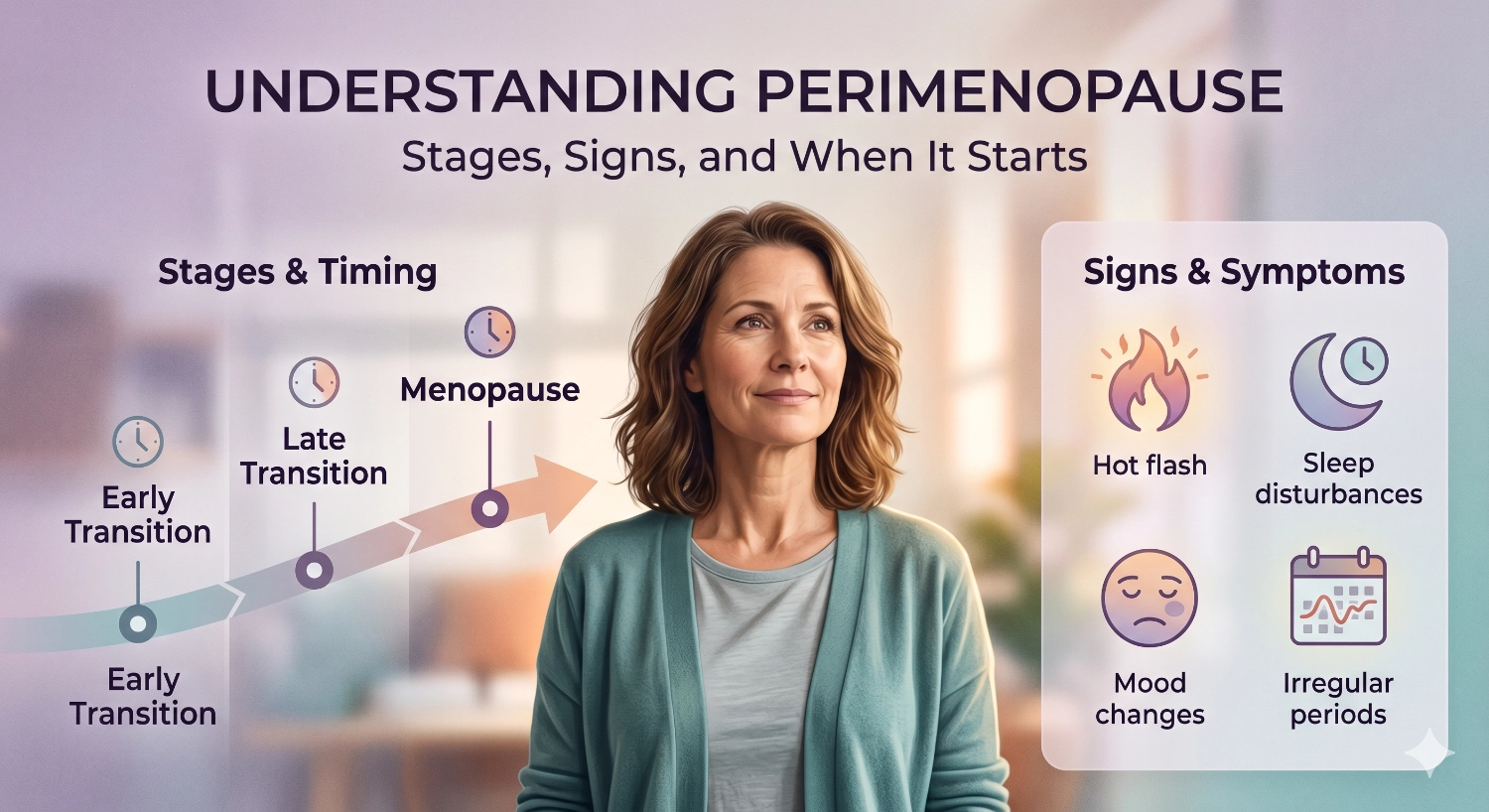
For many women, the body begins changing years before their last period ever arrives. Cycles shift. Sleep suffers. Moods swing without warning. This transitional window — often stretching across several years — is perimenopause, and understanding it can make an enormous difference in how you navigate it.
This guide explains exactly what perimenopause is, the first signs it's beginning, the four recognized stages, seven key symptoms to watch for, and the age at which most women can expect it to start.
What Is Perimenopause?
Perimenopause — sometimes called the menopausal transition — is the period during which your ovaries gradually begin producing less oestrogen (estrogen). It is not menopause itself; it is the lead-up to it. Menopause is officially confirmed only after 12 consecutive months without a menstrual period.
During perimenopause, ovulation becomes irregular and unpredictable. Because you can still ovulate, you can still become pregnant, even if your periods are sporadic.
The transition typically lasts around four years on average, though for some women it can be as brief as a few months or as long as ten years.
What Is the Usual Age of Perimenopause?
Most women enter perimenopause in their mid-to-late 40s, with 47 being the average age of onset. However, it is entirely normal for the transition to begin as early as the mid-30s or as late as the early 50s.
Several factors can influence when perimenopause starts:
Genetics
— if your mother or sisters experienced early perimenopause, you may too
Smoking
— smokers tend to begin the transition earlier than non-smokers
Cancer treatments
— chemotherapy and radiation can trigger early perimenopause
Surgical menopause
— removal of the ovaries (oophorectomy) causes immediate menopause, bypassing perimenopause altogether
Thyroid disorders
— thyroid conditions can affect hormone regulation and timing
Perimenopause that begins before age 40 is referred to as premature ovarian insufficiency (POI) and warrants a conversation with your GP or gynaecologist.
What Are the First Signs of Perimenopause Starting?
The very first sign of perimenopause for most women is a change in the menstrual cycle — specifically, a shift in the length, flow, or regularity of periods. This can go in either direction: some women find their cycles become shorter and more frequent, while others notice longer gaps between periods.
Other early signs that perimenopause may be beginning include:
Skipping a period
or going 60 or more days between periods
Heavier or lighter bleeding
than you're used to
Hot flashes
— sudden waves of heat, often accompanied by flushing of the face and chest
Night sweats
— hot flashes that occur during sleep, often disrupting rest
Sleep disturbances
— difficulty falling asleep or staying asleep, independent of night sweats
Mood changes
— increased irritability, low mood, or heightened anxiety, driven by fluctuating oestrogen levels
Because these early changes can be subtle and attributed to stress or other causes, many women do not initially recognise them as perimenopause. Tracking your cycle and noting any new symptoms is a practical first step.
What Are the 4 Stages of Perimenopause?
Perimenopause is not a single event — it unfolds in stages. The most clinically recognised framework is the STRAW+10 (Stages of Reproductive Aging Workshop) system, which maps the full reproductive lifespan. Within the menopausal transition, four key stages are recognised:
Stage 1: Early Menopausal Transition
In this stage, cycles remain present but begin to deviate from your established pattern by seven or more days. You may notice your cycle shortening or lengthening compared to what's normal for you. Symptoms are often mild at this point, and many women may not realise they're in perimenopause. Oestrogen levels are starting to fluctuate but have not dropped significantly.
Stage 2: Late Menopausal Transition
This stage is characterised by a gap of 60 or more days between periods. Hormonal fluctuations become more pronounced, and symptoms typically intensify. Hot flashes, night sweats, and sleep disruption become more common. Oestrogen levels are declining more noticeably, and FSH (follicle-stimulating hormone) levels rise as the body attempts to stimulate ovulation.
Stage 3: Final Menstrual Period
This is the last menstrual period a woman experiences — though it can only be identified in retrospect, once 12 months without a period have passed. This stage marks the dividing line between perimenopause and menopause. Vasomotor symptoms (hot flashes and sweating) are often at their peak around this time.
Stage 4: Early Postmenopause
This stage begins immediately after the final menstrual period and spans the first 12 months. Technically, a woman moves from "perimenopause" to "menopause" at this point, but many of the same symptoms persist — and some, like vaginal dryness and urinary changes, can become more pronounced as oestrogen levels settle at their new, lower baseline.
What Are 7 Signs of Perimenopause?
While every woman's experience is unique, the following seven signs are the most widely reported during the perimenopausal transition:
1. Irregular Periods
The hallmark sign of perimenopause. Your cycle may shorten, lengthen, become heavier, lighter, or simply unpredictable. Periods may arrive early, late, or occasionally skip a month entirely.
2. Hot Flashes
A sudden and intense feeling of heat — usually concentrated in the upper body, face, and neck — that can last between 30 seconds and 10 minutes. Hot flashes affect around 75% of women during perimenopause and can range from mildly warm to intensely uncomfortable.
3. Night Sweats
Night sweats are hot flashes that occur during sleep. They can be severe enough to drench clothing and bedding, making restful sleep difficult. Repeated disruptions accumulate into significant sleep deprivation over time.
4. Sleep Problems
Even without night sweats, many women in perimenopause struggle with insomnia — difficulty falling asleep, waking frequently, or rising too early. Declining progesterone, which has natural calming properties, is thought to play a key role.
5. Mood Changes
Oestrogen has a complex relationship with serotonin and other mood-regulating neurotransmitters. As levels fluctuate, women commonly experience increased irritability, anxiety, low mood, or emotional volatility. Women with a prior history of PMS or postnatal depression may be more susceptible.
6. Vaginal Dryness and Discomfort During Sex
As oestrogen declines, vaginal tissues can become thinner, drier, and less elastic — a condition known as genitourinary syndrome of menopause (GSM). This can cause discomfort or pain during intercourse, increased susceptibility to infections, and urinary urgency.
7. Reduced Libido
Changes in hormone levels — particularly oestrogen, progesterone, and testosterone — can reduce sexual desire. This is often compounded by sleep deprivation, vaginal discomfort, and mood changes occurring simultaneously.
Other symptoms that some women experience include brain fog, memory lapses, joint aches, changes in hair and skin, heart palpitations, and weight changes — particularly around the abdomen.
Managing Perimenopause: What Are Your Options?
Perimenopause is a natural biological process, but that does not mean symptoms have to be endured without support. Options vary depending on symptom severity and individual health history.
Lifestyle approaches — regular exercise, reducing caffeine and alcohol, a balanced diet rich in calcium and vitamin D, and good sleep hygiene can all help manage symptoms.
Hormone Replacement Therapy (HRT) — the most effective treatment for vasomotor symptoms like hot flashes and night sweats. Modern HRT comes in various forms (patches, gels, tablets, implants) and is considered safe for most healthy women. Always discuss with your doctor.
Non-hormonal medications — certain antidepressants, blood pressure medications, and other drugs have been shown to reduce hot flash frequency and intensity for women who cannot or prefer not to use HRT.
Cognitive Behavioural Therapy (CBT) — effective evidence-based approach for managing mood symptoms and sleep problems associated with perimenopause.
FAQ
How do I know if I'm in perimenopause?
The most common indicator is a change in your menstrual cycle — particularly cycles that become longer, shorter, heavier, lighter, or irregular. Accompanying symptoms like hot flashes, night sweats, or sleep disruption add further evidence. A blood test measuring FSH (follicle-stimulating hormone) can support a diagnosis, though levels fluctuate during perimenopause and no single test is definitive.
Can I still get pregnant during perimenopause?
Yes. Until you have gone 12 consecutive months without a period, you are still potentially fertile. Contraception is recommended if pregnancy is not desired.
How long does perimenopause last?
On average, four years — but it can range from a few months to over a decade. The late transition stage (when periods become very infrequent) tends to last one to three years before menopause is confirmed.
Are perimenopause and menopause the same thing?
No. Perimenopause is the transition phase during which hormones fluctuate and periods become irregular. Menopause is the specific point (confirmed retrospectively) when 12 consecutive months have passed without a period. Postmenopause refers to all the years after that.
What's the difference between perimenopause and PMS?
Both involve hormonal fluctuations that can affect mood, sleep, and physical comfort. The key difference is timing and pattern: PMS is cyclical and tied to the luteal phase of a regular cycle. Perimenopausal symptoms are more irregular, often more intense, and accompanied by changes to the cycle itself.
Conclusion
Perimenopause is a natural and universal stage of female biology — but it looks different for every woman. Understanding the four stages, recognising the earliest signs, and knowing which symptoms are most common puts you in a far stronger position to seek the right support.
If you suspect you're entering perimenopause, particularly if you're under 45 or experiencing significant symptoms, speak to your GP. Effective options — from lifestyle changes to HRT — exist to help you feel well throughout the transition and beyond.